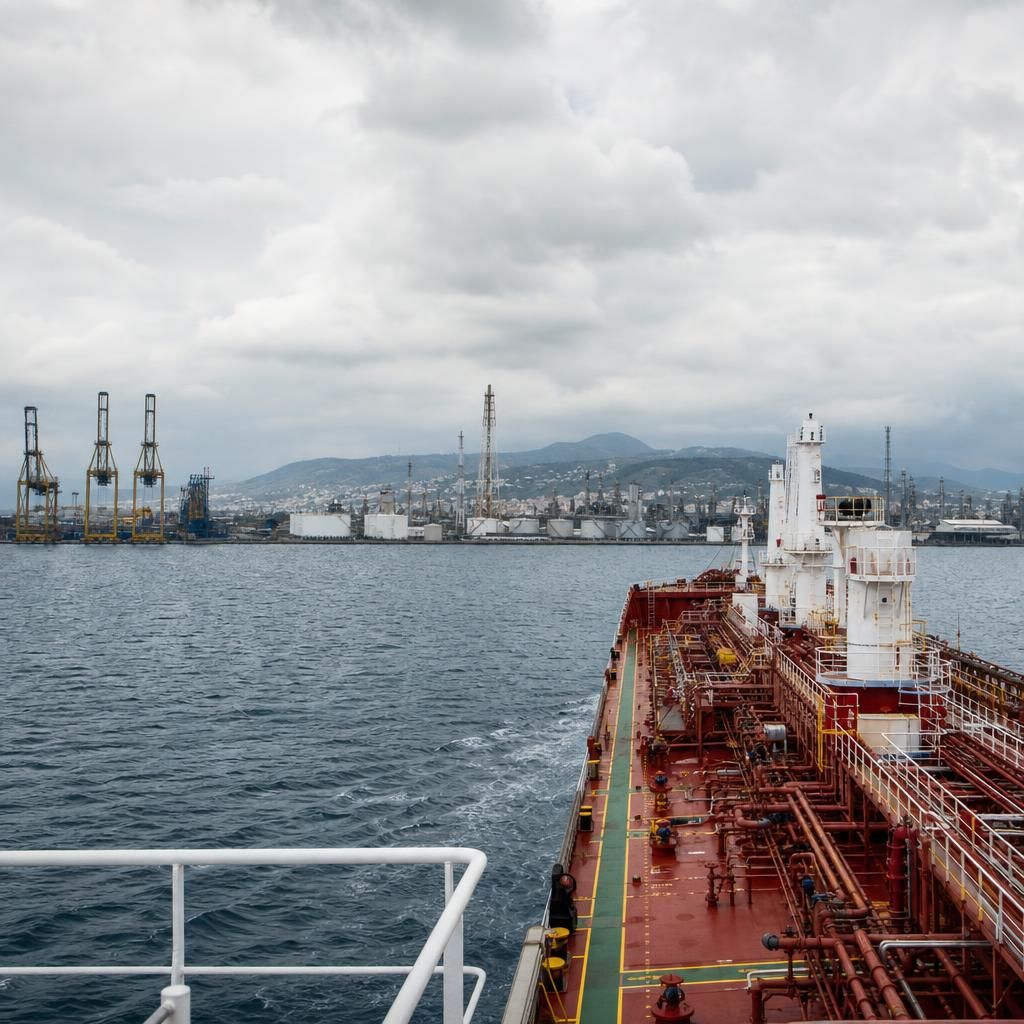
Hormuz Shipping Disruption Raises the Cost of Energy, Capital and Corporate Risk
Renewed attacks on commercial vessels in the Persian Gulf and Strait of Hormuz have pushed Brent crude above $100 a barrel, creating a broad inflationary shock for U.S. businesses just as financial markets are confronting higher Treasury yields and renewed Federal Reserve tightening concerns. The Strait handled roughly 20% of global oil and fuel volumes before the conflict, making further disruption a material risk to energy costs, transportation networks, operating margins and consumer purchasing power.
Energy markets move back to the center of the macro outlook
Brent crude rose to approximately $101.53 a barrel on Thursday, while West Texas Intermediate climbed to about $89.39, according to market reports. Shipping activity through the Strait of Hormuz has fallen to its lowest level in more than two months, while tanker attacks last week reached their highest weekly level since the beginning of the conflict.
The immediate economic effect is higher uncertainty around the availability and insurance cost of crude, refined products and liquefied natural gas. Even where cargoes continue moving, shipowners may demand greater risk premiums, reroute vessels, or delay sailings. Those costs ultimately flow through refiners, distributors and industrial customers.
For U.S. airlines, trucking companies, parcel carriers and other fuel-intensive businesses, a sustained increase in crude prices would raise direct operating expenses. Airlines may have hedges that delay the impact, but smaller carriers and logistics companies typically have less protection. Trucking and delivery firms can impose fuel surcharges, although those mechanisms often lag the underlying price move and do not fully protect margins when demand is weakening.
Corporate earnings face a margin test
The earnings impact will depend on each company’s pricing power, fuel exposure and geographic footprint. Energy producers and selected oilfield-service companies stand to benefit from higher realized prices, while refiners may see mixed results depending on crude differentials, product demand and inventory gains. Most non-energy sectors face a more difficult equation: higher input costs combined with uncertain ability to pass them on to customers.
Consumer-facing companies are particularly exposed. Higher gasoline and heating costs reduce household disposable income, leaving less money for discretionary goods, restaurants, travel and entertainment. Retailers may respond with promotions, but discounting can compound the pressure from freight, labor and inventory expenses. Companies selling necessities may preserve volumes more effectively, but even those businesses can experience private-label substitution and trading down.
Industrial manufacturers face a second-order risk through materials and transportation. Chemicals, plastics, metals, packaging and agricultural inputs are all sensitive to energy costs. A disruption that persists beyond a few weeks could force companies to revise procurement plans, increase safety stock and accept less efficient shipping routes. Those actions support supply-chain resilience but tie up working capital.
Supply chains become more expensive and less predictable
The Strait of Hormuz is a critical maritime chokepoint for Gulf exports. Disruption does not require a complete closure to affect global commerce. A lower number of safe transits can be enough to lengthen delivery times, increase freight rates and make cargo scheduling unreliable.
U.S. manufacturers with just-in-time inventories may face delays in fuel-related feedstocks and intermediate goods. Importers could bring forward shipments where capacity is available, adding congestion and storage costs. Businesses that rely on fixed-price contracts may absorb the initial increase, while those with flexible contracts may pass costs through more quickly but risk losing customers.
Supply-chain managers are therefore likely to prioritize route diversification, alternative suppliers and higher inventories. Those measures can reduce disruption risk, but they also weaken near-term returns on invested capital. For public companies, investors will look for evidence of rising inventory days, higher freight expenses and changes in working-capital guidance during upcoming earnings reports.
Higher oil prices reinforce the bond-market pressure
The energy shock is arriving alongside a separate financing challenge. Reports indicate that major technology companies, including SpaceX and Broadcom, are preparing potential debt issuance totaling roughly $80 billion. That prospective borrowing has intensified concerns that corporate financing could compete with Treasury issuance for institutional capital and push credit spreads wider.
At the same time, U.S. Treasury yields have reached their highest levels in decades, and the term premium—the additional compensation investors demand for holding long-term government debt—has risen to its highest level since 2014, according to market reporting citing the New York Federal Reserve’s model. Investors have also assigned a substantial probability to another Federal Reserve rate increase, with one market estimate placing the chance of an October hike at 70%.
Higher oil prices complicate the Fed’s policy trade-off. Energy costs can lift headline inflation directly and feed into transportation, production and wage expectations indirectly. If inflation remains persistent, policymakers may be less willing to ease financial conditions even if higher rates slow housing, business investment and consumer demand.
For U.S. businesses, the consequence is a higher hurdle rate for new projects. Capital-intensive industries such as data centers, semiconductor manufacturing, utilities and infrastructure are especially sensitive because their investment programs require large upfront borrowing. A combination of elevated Treasury yields, wider credit spreads and expensive construction inputs can delay projects or reduce expected returns.
AI investment meets a more demanding capital market
The AI infrastructure cycle has so far been supported by strong demand for computing capacity, but the funding model is becoming more important. Large-scale data centers require land, power, networking equipment and long-dated financing. If debt markets absorb a wave of new issuance while Treasury yields remain elevated, investors may demand stronger covenants, higher coupons or more equity participation.
That does not eliminate AI investment, but it can separate companies with durable cash flow from those dependent on refinancing. Technology suppliers with visible orders may remain comparatively well positioned, while highly leveraged infrastructure operators could face greater sensitivity to changes in financing costs and utilization assumptions.
The same conditions affect banks and private-credit lenders. Higher yields can improve interest income, but concentrated exposure to leveraged technology, commercial real estate or project finance raises underwriting risks. A prolonged period of expensive capital may also increase the likelihood of covenant amendments, delayed offerings and slower mergers and acquisitions.
What investors should monitor
Physical shipping conditions: Vessel transits, insurance premiums, rerouting decisions and the duration of any disruption will determine whether the oil shock remains temporary or becomes a broader supply constraint.
Corporate guidance: Fuel surcharges, pricing actions, inventory changes and revised margin expectations will show how quickly businesses are absorbing higher costs.
Inflation data: Energy pass-through into transportation, goods and services will influence whether the Federal Reserve maintains a tightening bias.
Debt issuance: The size and pricing of AI-related offerings will provide a real-time test of demand for corporate credit and the potential crowding-out effect on other borrowers.
Consumer behavior: Retail volumes, discretionary spending and delinquency trends will indicate whether higher fuel costs are materially weakening household demand.
Business outlook
The immediate impact of the Hormuz disruption is not uniform. Energy producers and companies with strong pricing power may benefit, while transport, manufacturing, retail and other fuel-sensitive sectors face margin pressure. The broader risk is the interaction between an energy shock and already restrictive financial conditions.
If shipping tensions ease, oil prices could retreat and companies may absorb the episode through hedging, inventory management and selective price increases. If attacks and transit restrictions persist, the U.S. economy would face a more difficult combination of higher operating costs, weaker discretionary demand and more expensive financing. For corporate earnings, supply-chain resilience and balance-sheet strength will matter as much as headline revenue growth.