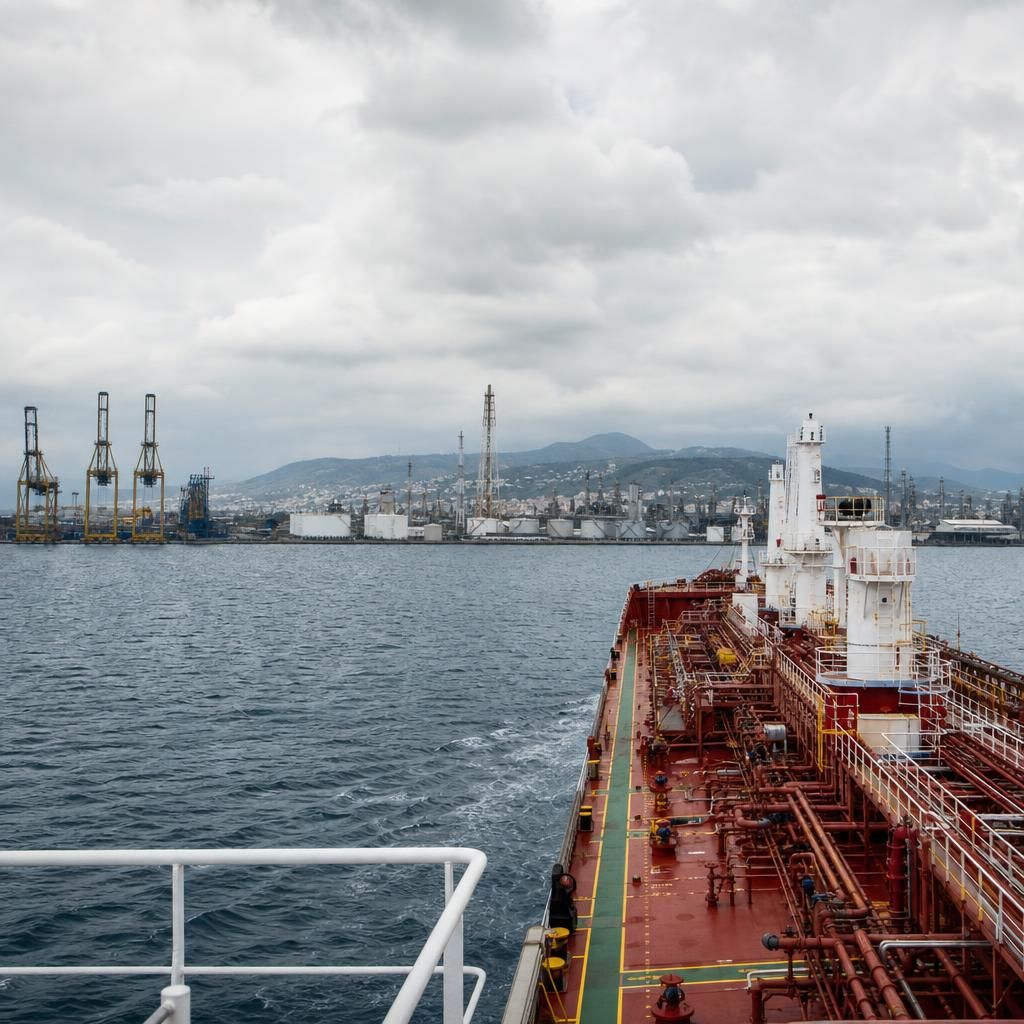
G7 Raises The Stakes On Hormuz As A Systemic Economic Risk
Finance ministers and central bank governors from the Group of Seven (G7) economies meeting in Paris this week have put the economic fallout from the Iran conflict and disruptions around the Strait of Hormuz at the center of their agenda. In their joint statement, officials said it was “imperative” to ensure a return to free and safe transit through the Strait of Hormuz and highlighted growing strains on energy, food, and fertilizer supply chains.
Multiple reports from the meetings indicate a clear shift from viewing the conflict as a regional security issue to treating it as a systemic macro and trade risk. According to coverage from Reuters and other international outlets summarized in your search results, the G7:
Called for the immediate reopening of the Strait of Hormuz to stabilize energy markets.
Vowed “multilateral cooperation” to address risks to the global economy stemming from the Middle East conflict.
Discussed contingency planning for shipping and energy disruptions, including their knock-on impact on vulnerable developing economies.
Reaffirmed pressure on Russia over Ukraine while also focusing on critical mineral supply chains, highlighting an increasingly interconnected security–trade agenda.
For US investors and corporates, this marks an important inflection point. The G7 is effectively signaling that Middle East tensions and constrained shipping lanes are no longer tail risks, but base-case constraints that need to be incorporated into policy and corporate planning. That shift is already affecting energy prices, freight costs, and risk premia across a range of US sectors.
Why The Strait Of Hormuz Matters So Much To US Business
The Strait of Hormuz is the chokepoint for roughly a fifth of the world’s crude oil flows and a significant share of global liquefied natural gas (LNG) shipments. Even with the US now a net exporter of energy on a volume basis, global benchmarks – particularly Brent crude – remain critical references for US fuel prices and input costs.
When the G7 states it is “imperative” to restore free transit through Hormuz, markets read that as a warning that:
Insurance premia and war-risk surcharges for tankers could remain elevated.
Shipping routes may be elongated or rerouted, tightening effective supply.
Additional sanctions or security measures could disrupt certain cargoes.
The immediate transmission channels into US corporate performance are clear:
Energy input costs: Higher oil and refined product prices feed directly into margins for transportation, manufacturing, chemicals, and consumer-facing sectors.
Freight and logistics costs: Vessel delays, rerouting, and higher insurance costs lift all-in freight rates for containerized goods and bulk commodities.
Working capital and inventories: Longer lead times and higher volatility encourage companies to hold more safety stock, tying up capital.
Demand side effects: Higher fuel and utility bills squeeze household disposable incomes, potentially weighing on discretionary spending.
Even for US companies less directly exposed to Middle East trade, these dynamics translate into a higher baseline for cost volatility and a lower margin of error in supply-chain planning.
Energy Markets: Winners, Losers, And Volatility
The Iran conflict and the G7’s explicit focus on Hormuz are reinforcing an underlying bid under global crude benchmarks. While exact price levels fluctuate day to day, news that G7 leaders see the situation as a critical macro risk tends to increase the geopolitical risk premium embedded in futures curves.
For US energy companies, the implications are differentiated:
Upstream producers: Independent oil and gas producers and integrated majors with strong upstream portfolios generally benefit from higher crude prices, provided disruptions do not directly impact their own export routes or operations. Their US operations, particularly in the Permian and other shale plays, become more valuable as relatively secure, politically stable sources of supply.
Refiners: US refiners face a more complex picture. Higher crude prices can compress margins if they cannot fully pass costs through to end products, especially in regions where refining capacity is tight and product demand is sensitive to price.
LNG and gas: Any perceived or actual hit to LNG flows from the Middle East tightens global gas markets, indirectly benefiting US LNG exporters that can command better pricing in Europe and Asia. That supports earnings for US firms with long-term offtake contracts and flexible cargoes.
Energy-intensive sectors, however, face margin pressure. Airlines, trucking firms, logistics providers, and industrial manufacturers are likely to see higher fuel and utility costs filtering into earnings. Those with robust hedging programs and strong pricing power may weather the pressure, but smaller operators or those in highly competitive end markets could struggle to defend margins.
Shipping And Logistics: Rising Costs And Rerouting
The G7 finance ministers also voiced concern over the broader fallout for global shipping. While the Strait of Hormuz is principally an energy chokepoint, sustained conflict and heightened security in adjacent waters contribute to a generalized risk-off stance among shipowners and insurers. This comes on top of other recent disruptions in global trade routes, including tensions in the Red Sea.
For US businesses, the key implications are:
Higher ocean freight rates: Even if specific US-bound routes do not pass through Hormuz, global fleets and insurance pools are interconnected. Elevated war-risk premiums and re-routing add to the global cost base, which can spill over into trans-Pacific and trans-Atlantic lanes.
Longer lead times: Where re-routing is necessary, transit times extend, increasing inventory-in-transit and complicating just-in-time production models.
Shift to regional sourcing: Persistent volatility encourages US firms to reweight sourcing towards North America, Latin America, and less exposed parts of Asia, even at higher unit costs.
US logistics and parcel companies may see mixed effects. On the one hand, higher global freight costs can enhance the competitive position of efficient, diversified carriers. On the other, customers facing higher transportation costs may push back on rate increases, pressuring margins in contract renegotiations.
Sector-Level Impact On US Earnings
Translating geopolitical risk into earnings forecasts is inherently uncertain, but the channels through which the G7’s warnings and the Iran conflict affect US corporates are increasingly visible. The impact will not be uniform:
Energy, Industrials, And Materials
Energy producers stand out as near-term beneficiaries of sustained higher price floors, particularly firms with minimal direct exposure to Middle East operations. Their capital spending plans may accelerate, supported by stronger cash flows.
Industrials and materials that rely on petrochemical feedstocks, diesel, or heavy fuel oil could face compression in gross margins unless they can pass through costs. Chemical producers, building materials companies, and heavy manufacturers will need to focus on pricing discipline and cost efficiency in upcoming quarters.
Transportation And Consumer-Facing Sectors
Airlines, trucking, and logistics firms will contend with elevated fuel bills. Many have fuel surcharge mechanisms in place, but these often lag spot price movements and may not fully offset volatility, particularly if demand softens at the same time.
For consumer-facing sectors – particularly discretionary retail, travel, and leisure – higher energy and food prices can erode disposable incomes. If the Iran conflict and Hormuz disruptions keep headline inflation elevated, the Federal Reserve’s ability to ease monetary policy may be constrained. That, in turn, affects financing costs for leveraged firms and capital-intensive business models.
Tech, Healthcare, And Services
More domestically oriented and intangible-heavy sectors like software, some areas of hardware, healthcare services, and professional services are comparatively insulated from direct cost shocks. Their exposure is more macro: if higher energy prices slow growth or keep interest rates higher for longer, multiples could compress even if operational performance holds up.
Supply Chains, Critical Minerals, And Strategic Realignment
Beyond immediate energy and shipping concerns, the G7 finance meetings also addressed broader supply-chain vulnerabilities, including critical minerals and rare earths. Officials discussed the need to reduce overreliance on China for inputs essential to electric vehicles, renewable energy, and defense systems, and signaled their intent to “deepen and expand” cooperation on critical mineral strategies.
The Middle East conflict reinforces a broader trend: major economies are moving from pure efficiency to resilience and redundancy in critical supply chains. For US businesses, this manifests in several ways:
Capex in alternative supply routes: Companies are investing in port infrastructure, inventory management systems, and regional production hubs to diversify away from single-point failures.
Strategic stockpiling: Firms in autos, aerospace, defense, and clean energy are more likely to hold buffer stocks of key inputs, raising working capital needs but reducing operational risk.
New partnerships and offtake agreements: US manufacturers and energy companies may prioritize long-term contracts with suppliers in politically aligned or lower-risk jurisdictions.
While these moves raise costs in the short term, they can support more stable earnings and reduce tail-risk exposures over the long run. Markets are already re-rating companies that demonstrate robust, diversified sourcing strategies.
Macro Backdrop: Inflation, Rates, And Growth
The G7’s Paris communiqué explicitly linked the Iran conflict and Hormuz disruptions to risks for global inflation and growth. For US policymakers and investors, the dilemma is straightforward:
Energy and shipping shocks tend to be inflationary in the short run, pushing up headline CPI via fuel, transport, and food prices.
At the same time, they are growth-negative, acting like a tax on consumers and energy-intensive industries.
If elevated energy and freight costs persist, the Federal Reserve may find it harder to deliver aggressive rate cuts without risking a de-anchoring of inflation expectations. That would keep financing costs for US corporates higher than they might otherwise be, particularly affecting real estate, small caps, and highly leveraged firms.
The G7’s call for multilateral coordination – including stronger support for vulnerable emerging markets through the IMF and World Bank – also matters for US businesses with significant exposure to developing economies. Targeted support can stabilize demand and reduce credit risk in key export markets, partially offsetting the drag from higher energy and freight costs.
Corporate Strategy And Investor Positioning
Against this backdrop, US management teams and investors are recalibrating strategy along several dimensions:
Hedging and procurement: More active use of energy and freight hedges, and diversified supplier networks, to smooth input costs.
Pricing power focus: Increased emphasis on investing in brands, technology, and service quality that support pricing power in an inflationary environment.
Balance sheet strength: Preference for companies with manageable leverage and ample liquidity to absorb volatility in costs and demand.
Geographic diversification: Balanced exposure between domestic and international markets, and within international portfolios, less concentration in high-risk regions.
From an investment perspective, sectors that can either pass through higher costs (such as certain consumer staples and regulated utilities) or that directly benefit from elevated energy prices (select energy and infrastructure plays) may see relative performance tailwinds. Conversely, industries that combine high energy intensity, limited pricing power, and balance sheet stress are likely to face prolonged pressure.
Conclusion: From Isolated Conflict To Structural Risk Factor
The G7 finance ministers’ meetings in Paris underscore that the Iran conflict and disruptions around the Strait of Hormuz have evolved from an isolated geopolitical flashpoint into a structural risk factor for the global economy. By explicitly highlighting the need to restore secure transit, warning of strains on energy, food, and fertilizer supply chains, and calling for coordinated policy responses, G7 leaders are signaling to markets and corporates that these risks must be built into baseline planning.
For US businesses, the implications are broad: higher and more volatile energy and freight costs, renewed pressure on margins in energy-intensive sectors, accelerated investment in supply-chain resilience, and a macro environment where inflation and growth risks are more finely balanced. While some sectors – notably upstream energy and certain logistics and infrastructure players – may benefit, the overall picture is one of elevated uncertainty and a premium on operational flexibility.
Investors who differentiate between firms that proactively manage these new constraints and those that remain exposed to single-route, low-resilience models are likely to navigate this environment more effectively. As the G7’s Paris meetings make clear, the intersection of geopolitics, trade, and energy security is no longer peripheral to corporate earnings; it is a central driver of both risk and opportunity in the current cycle.