
AI Data Center Boom Faces Power Crunch and Labor Shortages: $650B Buildout at Risk
The United States is in the midst of an unprecedented data center construction surge, fueled by explosive demand for artificial intelligence infrastructure. New analysis from the Pew Research Center indicates over 1,500 data centers are currently in development, with 67% targeted for rural communities outside urban areas.[1] This shift marks a stark contrast to the existing landscape, where 87% of operational facilities remain concentrated in cities. States like Virginia, Texas, and Georgia are leading the charge, with 287, 170, and 141 planned projects respectively.[1]
At the heart of this boom is AI's insatiable appetite for computational power. Hyperscalers such as Microsoft, Amazon Web Services, Google Cloud, and Meta are pouring billions into expanding their footprints to support generative AI models and large language processing. However, this expansion is hitting significant headwinds: power grid constraints, regulatory pushback, and a tightening labor market for skilled trades. Nearly half of all U.S. AI data centers slated for 2026 have been delayed or canceled, creating a staggering 7 gigawatt (GW) capacity shortfall amid a projected $650 billion buildout.[2] These challenges are not merely operational hurdles; they carry profound implications for technology company valuations, stock performance, and investor strategies in the sector.
The Scale of the AI-Driven Expansion
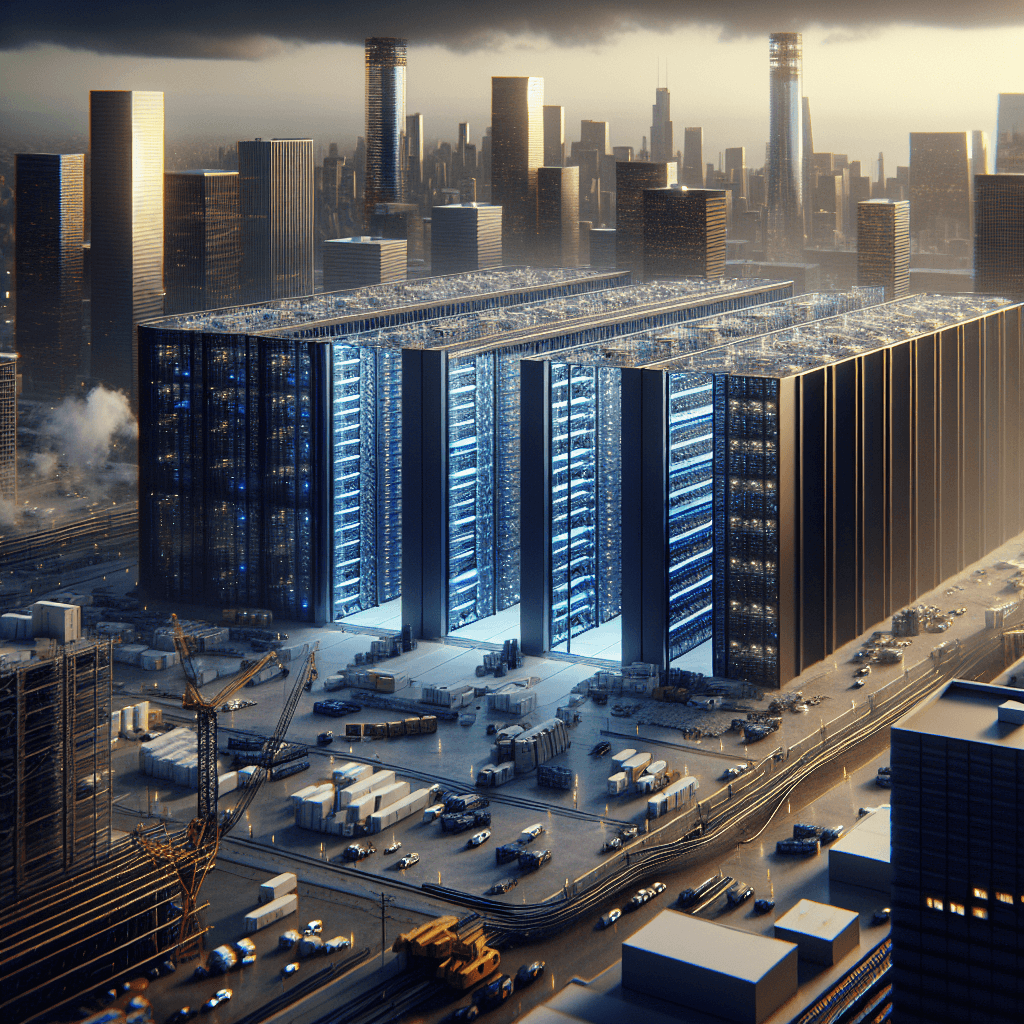
Data center construction is booming nationwide, particularly in rural areas where land is abundant and costs are lower. An aerial view from Vernon, California, captures a 49.5 megawatt three-level facility under construction as of April 14, 2026, emblematic of the scale.[1] Virginia, already home to the world's highest concentration of data centers, continues to dominate with hundreds of new projects. Texas and Georgia follow closely, benefiting from favorable energy profiles and pro-business policies.
AI is the primary catalyst. Training and inference for models like those powering ChatGPT or Grok require immense clusters of graphics processing units (GPUs) and central processing units (CPUs), all running on direct-current (DC) power within high-density racks.[3] This has elevated rack power demands to levels where conversion losses from alternating current (AC) grid supplies are no longer negligible, exacerbating energy challenges.[3] Globally, the trend mirrors the U.S., with TikTok announcing a €1 billion ($1.16 billion) investment in a 50 MW data center in Lahti, Finland, scalable to 128 MW, just this week.[3]
For tech companies, this infrastructure race is a capital-intensive bet on future dominance. NVIDIA, the GPU kingpin, benefits indirectly as its chips populate these facilities, with shares up over 150% in the past year on AI hype. Pure-play data center REITs like Digital Realty Trust (DLR) and Equinix (EQIX) have seen robust gains, trading at premiums to net asset values amid lease-up rates exceeding 90%.
Power Grid Bottlenecks: The 7GW Crisis
Power availability has emerged as the single biggest constraint. The 7GW capacity gap for 2026 alone underscores systemic issues in the U.S. grid, strained by aging infrastructure and slow permitting for new generation.[2] Data centers now consume about 4% of U.S. electricity, projected to double by 2030, rivaling the power draw of entire states like Utah.
Utilities are scrambling. Partnerships like Utilidata and NexGen Cloud are deploying AI-optimized power control platforms to squeeze more compute from existing grids, announced March 12.[3] Yet, these band-aids fall short of the structural upgrades needed. In Maine, the legislature passed the nation's first moratorium on AI data centers over 20 MW, pending until October 2027, with Governor Janet Mills undecided as of Friday.[1] Similar measures loom in Virginia and Arizona, where local opposition cites water usage and emissions.
The financial ripple effects are immediate. Microsoft delayed a $10 billion Ohio project last quarter due to power shortages, while Amazon mothballed expansions in Pennsylvania. These setbacks have introduced volatility into hyperscaler stocks: Amazon (AMZN) dipped 3% post-earnings on capex warnings, despite AWS growth hitting 17%. Investors should monitor utility stocks like NextEra Energy (NEE) and Dominion Energy (D), positioned to capitalize on transmission builds, potentially yielding 20-30% upside as data center PPAs (power purchase agreements) flood in.
Skilled Labor Squeeze Intensifies
Compounding the power woes is a severe shortage of skilled trades, accelerated by the AI buildout. A Randstad USA analysis of 150 million job postings from 2022-2026 reveals demand for robotics technicians surging 113%, HVAC engineers up 78%, and industrial automation roles climbing 51%.[4] Electricians, welders, and construction specialists saw average gains of 30%.[4]
Time-to-hire for these roles now averages 56 days, surpassing the 54 days for white-collar jobs.[4] Greg Dyer, chief commercial officer at Randstad North America, warns that skilled trades are "the engine and bottleneck" for AI growth.[4] Data centers require specialized HVAC for cooling dense GPU racks, advanced electrical systems for high-voltage feeds, and robotics for automated maintenance.
This labor crunch inflates construction costs by 15-20%, per industry estimates, squeezing margins for operators. Companies like Vertiv Holdings (VRT), a leader in cooling and power management, have rallied 200% in 12 months on order backlogs, trading at 45x forward earnings. Similarly, Eaton Corporation (ETN), providing electrical gear, benefits from the scramble. For investors, this dynamic favors industrials over pure software plays, with ETFs like the First Trust NASDAQ Clean Edge Smart Grid Infrastructure Index Fund (GRID) offering diversified exposure.
Market Implications for Tech Stocks and Investors
Tech equities remain bifurcated. AI winners like NVIDIA (NVDA), up 220% YTD, and Broadcom (AVGO) trade at nosebleed multiples (60x+ P/E), vulnerable to any buildout slowdowns. Hyperscalers face capex creep: collective 2026 spend projected at $200 billion, up 50% YoY, pressuring free cash flow. Microsoft's Azure growth hit 33% last quarter, but CEO Satya Nadella flagged supply constraints.
Conversely, opportunities abound in the "picks and shovels" segment. Digital Realty's Q1 lease spreads widened to 40 basis points, with ABR (average booking rate) at $45 per kW/month. Iron Mountain (IRM), pivoting to data centers, trades at a 20% discount to peers, offering 4.5% yield plus growth. Smaller caps like Super Micro Computer (SMCI), supplying rack systems, have exploded but warrant caution amid volatility.
Risk factors include regulatory escalation and recession risks curbing AI monetization. Bullish catalysts: nuclear revival (e.g., Microsoft's deal with Constellation Energy) and edge computing hybrids reducing central demand. VCU's Peter Aiken notes the future may surprise, with efficiency gains tempering raw build needs.[5]
Strategic Outlook for Investors
In this $650 billion arena, prudence pays. Allocate 10-15% to data center enablers: 40% REITs (DLR, EQIX), 30% power/industrials (VRT, ETN, NEE), 20% semis (NVDA, AVGO), 10% utilities. Avoid overconcentration in hyperscalers until power inflection.
The boom persists—rural America gains 67% of projects—but execution risks loom large.[1] Investors eyeing 12-18 month horizons can capture 15-25% sector returns, blending growth with infrastructure resilience. As AI scales, those bridging the power-labor chasm will define the next leg higher.
Word count: 1,048

