
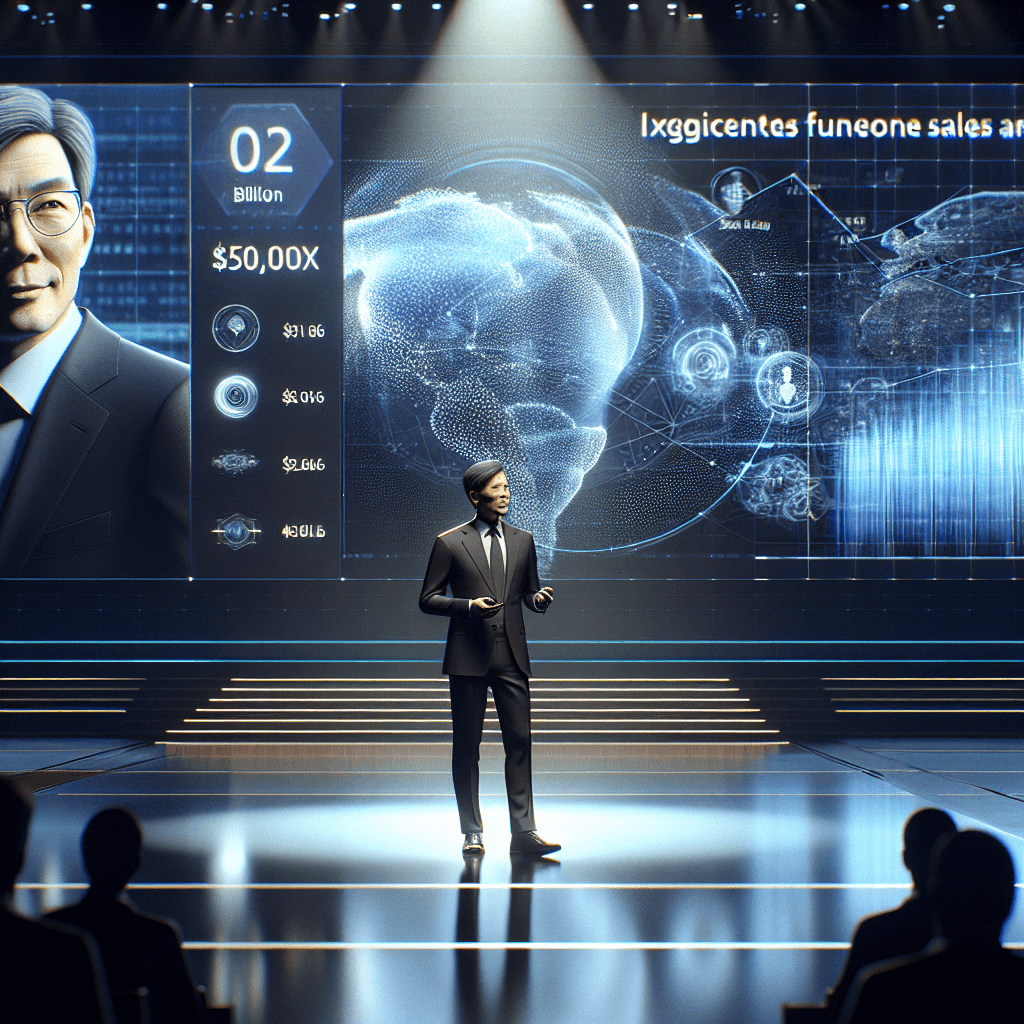
NVIDIA's GTC 2026 Keynote Ignites AI Momentum: $500B Blackwell and Rubin Sales Outlook Signals Sustained Dominance
On March 16, 2026, NVIDIA Corporation (NVDA) CEO Jensen Huang delivered his annual keynote at the GTC conference in San Jose, California, setting the stage for what could be another transformative year in artificial intelligence hardware.This event, unfolding amid heightened market volatility ahead of the Federal Reserve's decision, reaffirmed NVIDIA's central role in the AI revolution, with projections of $500 billion in sales from its Blackwell and Rubin platforms through the end of calendar 2026.[1][2][3]
Key Highlights from Huang's Keynote
Huang's presentation emphasized NVIDIA's accelerating trajectory in AI accelerators, spotlighting the Blackwell architecture and the forthcoming Rubin platform. The CEO indicated that sales from these two platforms alone are on track to exceed the $500 billion mark by year-end 2026, with current performance already surpassing internal benchmarks.This forward-looking guidance represents a monumental scale-up from prior quarters, where NVIDIA reported explosive revenue growth driven by data center demand.[2][3]
Attendees and analysts noted Huang's focus on ecosystem integration, including NVIDIA's recent acqui-hire of AI inference chip designer Groq. This move positions NVIDIA to potentially incorporate advanced inference technologies into its processors, enhancing efficiency for real-time AI applications across enterprise and consumer segments.[3]
Market observers at the event, including Bloomberg Tech co-hosts, highlighted the anticipation surrounding updated numbers. "The market is waiting on that number to go up," one commentator remarked, underscoring how any upward revision could propel NVDA shares higher despite recent trading consolidation.[2]
Market Reaction and Stock Performance Context
NVDA shares traded water amid the keynote, reflecting investor digestion of the company's rapid growth trajectory. From 2022 to 2024, the stock surged approximately 800%, establishing NVIDIA as the world's most valuable company by market cap at peaks.[2] However, with such parabolic gains, the bar for continued ascent has risen, prompting scrutiny of whether NVIDIA can sustain its gradient amid maturing AI adoption cycles.
Broader market dynamics played into the GTC narrative. U.S. indices advanced on March 16, with the S&P 500 gaining 1%, Dow up, and NASDAQ climbing 308 points, while the VIX hovered near 23 ahead of the Fed meeting.[2] Tech peers showed mixed results: Adobe down 7.5%, Broadcom 4%, Meta, Salesforce, and Oracle also declining, contrasting with NVIDIA's resilience.[4]
Schwab Network analyst Jessica Inskip flagged GTC 2026 as a key catalyst for NVDA this week, alongside enterprise opportunities at IBM and Apple's consumer AI push. Chart analysis by Rick Ducat supported bullish technical levels, suggesting potential breakout if guidance exceeds expectations.[1]
Ecosystem Expansions Bolster NVIDIA's Moat
Beyond core hardware, NVIDIA's partnerships amplified GTC's significance. Strategic ally Nebius secured a deal with Meta Platforms (META) for up to $27 billion in AI infrastructure capacity starting 2027, enabling Meta's aggressive spend to compete in generative AI.[2][3] Nebius shares gained 16% on the news, validating the hyperscaler's infrastructure demand.
This arrangement exemplifies how NVIDIA's influence extends through its supply chain. Meta's commitment aligns with its prudent cost management, including headcount trims to protect margins while ramping AI investments. Street interpretations view such moves positively, recognizing the balance between spending and efficiency.[2]
Huang also showcased customer wins, referencing support for PyTorch and Jackson XLA accelerators serving Base 10s, CrowdStrike, Puma, and Salesforce. These integrations highlight NVIDIA's versatility beyond training to inference and edge computing.[3]
Implications for Big Tech Peers
GTC 2026 reverberates across big tech. Apple (AAPL) eyes consumer AI leadership via Siri enhancements potentially tied to iPhone 17, while IBM leverages blockchain and enterprise software atop NVIDIA's stack.[1] Microsoft's Azure and Google's Cloud, heavy NVIDIA users, face similar capacity crunches, potentially accelerating custom silicon but reinforcing short-term reliance.
Meta's Nebius deal signals hyperscalers outsourcing infrastructure to scale AI ambitions. With OpenAI reportedly drawing $4 billion from partners at a $10 billion valuation, the AI funding ecosystem thrives, indirectly buoying NVIDIA's revenue pipeline.[2]
Financial Metrics and Growth Projections
NVIDIA's data center segment, now over 80% of revenue, continues to power results. Prior quarters saw triple-digit growth, with Blackwell ramping production. The $500 billion outlook implies annualized run-rates eclipsing prior peaks, assuming no major disruptions.
Valuation metrics remain stretched: forward P/E above 40x amid 100%+ growth, but free cash flow generation supports buybacks and capex. Analysts project sustained EPS expansion if AI capex from FAANG peers holds, estimated at $100B+ annually industry-wide.
Risks include supply chain bottlenecks, U.S.-China tensions impacting exports, and potential AI hype normalization. Yet, GTC's messaging counters this, emphasizing multi-year demand from sovereign AI initiatives and enterprise digitization.[1][2]
Investment Outlook: Bullish with Measured Expectations
For institutional investors, NVDA remains a conviction holding in tech portfolios. GTC 2026's guidance cements its moat in AI silicon, where switching costs are prohibitive. Paired with ecosystem deals like Meta-Nebius, the thesis for 50%+ upside through 2026 holds firm, targeting $200+ share price on expanded multiples.
Portfolio allocation: 5-10% for growth mandates, hedged via options amid Fed uncertainty. Peer diversification into AMD or TSM mitigates concentration, but NVIDIA's platform leadership endures.
In summary, Jensen Huang's keynote not only validated NVIDIA's trajectory but elevated the AI narrative. As markets process these developments ahead of Fed clarity, NVDA stands poised to lead big tech's next leg higher, rewarding patient capital with compounding returns.
BullishDaily provides institutional-grade analysis. Data sourced from real-time market coverage on March 16, 2026.[1][2][3][4]

