
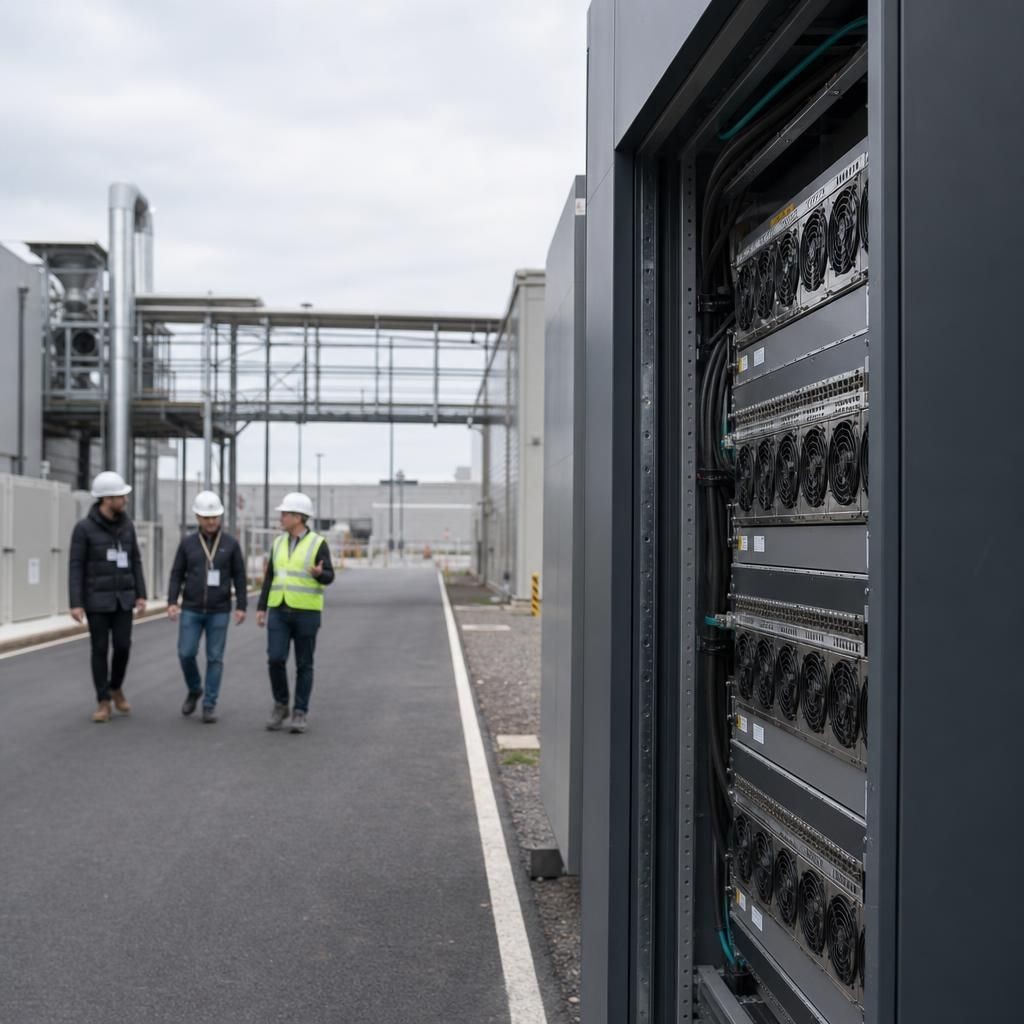
Amazon is reportedly considering an approximately $8 billion financing structure for Nvidia AI chips already installed across its U.S. data centers, a transaction that would offer investors a fresh view into how hyperscalers are funding the unprecedented infrastructure buildout behind generative artificial intelligence.
According to reporting summarized on October 3, 2026, Amazon has discussed transferring thousands of Nvidia Grace Blackwell systems into a special-purpose vehicle funded by outside investors, potentially through a combination of debt and as much as a 10% equity stake. Amazon would then lease the equipment back and continue using it in its data centers.
Asset-light financing enters the AI infrastructure cycle
The proposed structure would not reduce Amazon’s underlying demand for computing capacity. Instead, it would change how part of that capacity appears on the company’s balance sheet and how the associated capital requirements are funded. By selling or transferring equipment to a dedicated vehicle and leasing it back, Amazon could preserve operational access to the chips while bringing in external capital.
That approach reflects the scale and speed of the current AI infrastructure cycle. Nvidia’s Grace Blackwell platforms are among the most valuable and sought-after systems used for large-model training and inference. Moving approximately $8 billion of equipment into an investor-backed vehicle would demonstrate that AI hardware is increasingly being treated not only as technology infrastructure, but also as a financeable asset class with identifiable cash flows and residual value.
For Amazon Web Services, the immediate financial benefit would be greater flexibility in managing capital expenditure. AWS requires substantial investment in servers, networking, power systems, and data-center capacity to meet demand from enterprise customers and AI developers. Leasing selected hardware could reduce the amount of upfront cash committed to equipment, although the company would assume ongoing lease obligations and potentially higher total financing costs.
Implications for Amazon and hyperscaler spending
The proposal should not be interpreted as evidence that Amazon is retreating from AI investment. The reported structure is more consistent with an effort to support continued expansion while improving capital efficiency. Amazon’s ability to lease back the chips would allow it to maintain access to the computing resources required for AWS customers even after ownership is transferred.
For investors, the key issue is whether the financing supports profitable utilization. AI hardware generates economic value only when it is deployed at sufficiently high utilization rates and priced above its operating, depreciation, energy, and financing costs. A leaseback can accelerate deployment, but it does not eliminate those costs. The quality of the investment therefore depends on AWS demand, customer pricing, power availability, and the useful life of the equipment.
The structure could also become a template for other hyperscalers. Microsoft, Alphabet, Meta Platforms, and other large cloud operators are making major commitments to AI accelerators and data-center capacity. If outside investors are willing to finance specialized hardware, hyperscalers may gain another tool for matching infrastructure spending with customer revenue.
However, broader adoption would introduce additional complexity. Investors would need to assess lease liabilities, guarantees, residual-value assumptions, and the extent to which equipment is financed through entities that sit outside the parent company’s balance sheet. Credit analysts would also examine whether the arrangement changes leverage or fixed obligations in a way that is not immediately visible in headline capital-expenditure figures.
Nvidia remains the central beneficiary
The reported Amazon transaction reinforces the strength of Nvidia’s position in the AI supply chain. If Amazon transfers approximately $8 billion of Nvidia systems into a financing vehicle, the transaction would still represent substantial demand for Nvidia hardware. The financing method would change the ownership structure, not the requirement for the chips themselves.
Market coverage on October 2 described Nvidia shares reaching a new high above $237 before moderating. Separate market reporting cited gains of 3.27% for Nvidia, 2.85% for AMD, and 2.14% for Broadcom, with investors linking the semiconductor rally to continued capital-expenditure commitments by major technology companies.
The significance for Nvidia is that hyperscaler spending can remain supportive even if individual companies seek more efficient funding models. Barclays was reported to estimate that Nvidia could capture at least $30 billion of additional revenue across 2026 and 2027 if cloud-company investment continues. The same coverage cited an expectation that global cloud capital expenditure could approach $1.1 trillion by 2027, with approximately 80% allocated to information technology.
Those figures are forecasts rather than reported results, and they remain sensitive to customer demand and supply-chain execution. Nevertheless, the Amazon financing discussion provides a useful indication of the financial pressure created by the AI buildout: the issue is increasingly not whether companies want more accelerators, but how quickly they can deploy and fund them.
Stock-market impact and investor considerations
For Amazon shareholders, the financing plan presents both potential benefits and risks. The positive case is that external funding could allow AWS to expand AI capacity without relying exclusively on operating cash flow or conventional corporate borrowing. Faster capacity deployment could help Amazon capture enterprise workloads and strengthen its position against Microsoft Azure and Google Cloud.
The risk is that financing can obscure the full economic cost of expansion. Lease payments are contractual obligations, and a special-purpose vehicle may require investor protections or guarantees. If AI demand grows more slowly than expected, Amazon could remain committed to payments on hardware with declining utilization or falling market value.
For Nvidia investors, the report is constructive because it confirms that customers continue to find ways to finance large orders of advanced systems. Yet it also highlights concentration risk. Nvidia’s revenue growth depends heavily on a limited number of very large buyers, and those buyers are becoming increasingly focused on returns, financing costs, and utilization. A transition from outright purchases to leasing could preserve demand while making customer economics more transparent—and potentially more demanding.
For semiconductor peers such as AMD and Broadcom, the development is relevant because it validates the broader market for AI accelerators, custom silicon, networking, and data-center infrastructure. The strongest beneficiaries will be companies that can offer differentiated performance, reliable supply, and competitive total cost of ownership. Hardware demand alone will not guarantee equal gains across the semiconductor sector.
Valuation and execution remain decisive
The market’s enthusiasm for AI infrastructure has already lifted valuations across parts of the technology sector. That creates a higher burden of proof for companies whose share prices reflect years of expected growth. Investors must distinguish between reported orders, committed capital expenditure, financing arrangements, and revenue generated from deployed systems.
The Amazon proposal is particularly important because it connects those four stages. Orders create demand for chip suppliers, financing supports deployment, and AWS revenue must ultimately justify the investment. Any weakness in the chain could affect returns for both technology companies and their shareholders.
Energy and data-center constraints also remain material. Amazon separately announced a $1 billion investment over five years in communities hosting its U.S. data centers, according to market coverage, in response to concerns about electricity and water consumption. That initiative underscores that AI expansion depends on local infrastructure and public acceptance as much as on chips and capital.
For institutional investors, the most relevant indicators will be cloud revenue growth, AI-related bookings, data-center utilization, operating margins, capital intensity, and the composition of lease and debt obligations. Companies that can demonstrate strong customer monetization and disciplined financing should be better positioned than those relying primarily on rising asset values or continued market enthusiasm.
What the development means for the technology sector
Amazon’s reported $8 billion chip-financing discussion signals a maturing phase of the AI investment cycle. The sector is moving beyond the initial question of who can buy the most accelerators and toward questions of ownership, funding, utilization, and returns on invested capital.
That shift is broadly constructive for established hyperscalers because it expands their financing options. It is also a reminder that AI infrastructure carries fixed costs and execution risks. The next phase of the technology rally will depend less on headline spending alone and more on whether cloud providers can convert enormous hardware commitments into durable revenue, stronger margins, and credible free-cash-flow growth.

